


Universal Fund
Everyone deserves the chance to
build a future: education, practical skills and hope for children and young people affected by HIV in Uganda
*You may know it as the Child Sponsorship Fund. It's been part of Mildmay's work in Uganda since 2002
THANK YOU. Our Summer Appeal raised more than £35,000 for the Universal Fund. Gifts are still welcome.
Mildmay Uganda’s Universal Fund is a lifeline for children, young people, and families living with HIV.
The Fund provides a holistic "wrap-around" model of care: healthcare, education, food security, and economic empowerment.
Children affected by HIV in Uganda face overlapping barriers: poverty, stigma, disrupted education and limited access to opportunity. For two years, funding shortfalls forced the Universal Fund to a near standstill. By 2024, no children were being supported into formal education at all.
That changed in the spring of 2026. An initial £10,000 grant from UK supporters allowed Mildmay Uganda to restart the programme, and around 40 households have already re-entered.
Our summer appeal built on that, with more than £35,000 given by supporters across the UK. This means many more young people can be supported through school and training in 2027. The Fund has restarted at a smaller scale, and with continued support it can grow back to reach many more young people.

Thousands of children have been supported by the Universal Fund over several decades.
Support the Universal Fund. Donate today and help restore opportunity.
WHY THIS PROGRAMME MATTERS
Why your support is needed
Children affected by HIV are more likely to experience interrupted education, food insecurity and long-term poverty. For many families, school fees, uniforms and basic supplies are simply unaffordable.
Education and skills training remain among the most effective ways to break this cycle, improving health outcomes, economic resilience and long-term independence.
Mildmay Uganda’s approach recognises that children do not experience challenges in isolation. That is why the Universal Fund combines education with psychosocial support, healthcare access and family strengthening.

WHAT THE UNIVERSAL FUND DOES
Since 2002, the Universal Fund has supported vulnerable children and young people through a holistic package of care, including:
-
Access to primary and secondary education
-
Vocational and skills training — from hairdressing, tailoring and soap-making to, this year, motor vehicle and motorcycle mechanics for the first time
-
Psychosocial and family support
-
Food and nutrition support, where needed
-
Ongoing follow-up by social workers
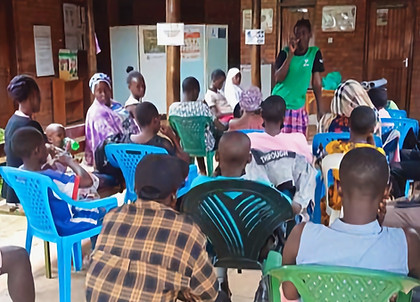
Adolescents and young people taking part in a facilitated adherence information session, supported by a trained mentor, in a safe, informal group setting.
Since 2017, the programme has operated as a universal fund rather than individual sponsorship, so support reaches the most vulnerable children equitably, based on need.
IMPACT AT A GLANCE
-
Around 40 households re-entered the programme this spring, following two years on hold
-
72 children and young people identified as needing support within those households
-
39 already receiving education or economic support, with more to follow as funding allows
-
Over 2,000 children and young people supported since 2002
WHAT'S HAPPENING NOW
Years of challenge and why support matters now
Like many community programmes, the Universal Fund was hit hard by reduced funding after the Covid-19 pandemic. By 2024, no children were being supported through formal education, and by 2025 even skills training had stopped. That reflected funding, not falling need; the demand for support never went away.
This spring, an initial £10,000 grant from our supporters in the UK allowed Mildmay Uganda to restart the fund.
Around 40 households have re-entered the programme so far. Social workers and peer supporters identified 72 children and young people across those households who need support; 39 are now receiving education or skills training, with more expected to join as funding allows.


Household and vocational assessments
WHO WE HAVE HELPED OVER THE YEARS
The trends shown in the table below highlight not a reduction in need, but the importance of restoring education support, which remains central to empowering young people and strengthening communities over the long term.
Year
Formal education
Socio-economic
skills
Vocational skills
Tertiary education
2020/21
2021/22
2022/23
2023/24
2024/25
2025/26
Total
129
65
96
5
0
0
295
0
13
30
50
25
0
118
0
7
7
2
0
0
16
0
3
3
1
0
0
7
2026/27* - - - -
*The Universal Fund restarted in April 2026, with the first participants now receiving support. Full-year figures will be published here once the year closes - check back for updates.
0
children and young people were helped in 2025/26
Reduced funding has severely limited access to formal education in recent years.
During this period, the programme prioritised socio-economic skills training, reaching more adolescents and young people between 2021 and 2023, before activity declined again in 2024.
CASE STUDIES: STORIES OF CHANGE
A Second Chance: Samira's Story

When Samira became pregnant during Uganda's 2021 COVID-19 lockdown, she feared her dream of becoming a lawyer was over.
She grew up in Wakiso District with her mother and seven siblings, in a household that struggled to make ends meet. When school fees became unaffordable, Samira left education to work as a housemaid to help support her family.
"I always wanted to become a lawyer, to defend the rights of vulnerable young mothers in my community," she says.
Community Health Volunteers working with Mildmay Uganda identified Samira and referred her to Mildmay Uganda Hospital, where she received antenatal care, psychosocial support and maternal health services throughout her pregnancy. She went on to deliver a healthy baby girl.
"I delivered my baby with peace of mind. The health workers cared for me with kindness and taught me how to look after her. I felt at home."
Through the Universal Fund's safe-space programme, Samira trained in tailoring, hair plaiting and soap making, skills she now uses to provide for her daughter. She has also been reintegrated into formal education and is preparing to sit her Uganda Certificate of Education in November 2026.
"With the support I have received from Mildmay, I am confident I will achieve my dream of becoming a lawyer."
Determined to Become a Doctor: James's Story

James's mother died of an HIV-related illness in 2013, leaving his father to raise him and his three siblings alone in Masaka District, central Uganda.
The family later moved to the Kampala area, where his father ran a small stall business to make ends meet. When illness stopped his father working, the household income collapsed, and James's education was at risk.
"My household was facing financial difficulties that affected my schooling. I was unable to continue because my father could not afford the fees."
Through the Universal Fund, James was identified and enrolled for support, covering school fees, health services, psychosocial care and materials, and allowing him to stay in education.
He has since become a peer educator with Uganda's Presidential Initiative on AIDS Strategy for Communication to Youth (PIASCY), helping raise HIV awareness among fellow students.
"My dream is to become a medical doctor, so I can serve my community and contribute to the fight against HIV and AIDS."
His father is blunt about what the support has meant: it "has given him the opportunity to continue learning and pursue his dreams."
Earlier case studies

Living Proof: Ruth’s Journey to Nursing
Ruth grew up in a rural community over 190km from Kampala. At age 12, she was diagnosed with HIV/AIDS.
Living in a household of ten where her father struggled as a peasant farmer, Ruth’s dream of becoming a nurse seemed impossible. Through the Universal Fund, Ruth was enrolled in Antiretroviral Treatment (ART) and supported through school, from Primary One all the way through to Nursing School. “Due to our meagre household income, I had no hopes of joining school. My father could not afford the school fees. My dream was shattered. Today, I am a qualified nurse. I can give back to my community, and one day, I will hold someone’s hand too!” says Ruth. Ruth is one of more than 1,200 girls whose lives have been transformed through the Orphans and Vulnerable Children/Youth (OVCY) Initiative led by Mildmay Hospital Uganda.

Catherine’s story
Catherine, 22, grew up in Kampala and had been receiving care at Mildmay Uganda since childhood after losing both parents to HIV.
Despite maintaining good treatment adherence and achieving viral suppression, stigma within her family interrupted her education. Through Mildmay Uganda’s support, Catherine was able to return to school, complete her secondary education, and later gain a certificate in guidance and counselling. She is now working as a Young People and Adolescent Peer Supporter, helping other adolescents access HIV testing, treatment, adherence support and counselling services. With her earnings, Catherine enrolled for a diploma in guidance and counselling and graduated as a professional counsellor in 2022, while continuing to support her peers and family.
SKILLS FOR INDEPENDENCE

Economic stability is the foundation of health. For young mothers like Tracy, vocational training is the difference between poverty and a career.
After joining our hairdressing apprenticeship, Tracy (left) now earns approximately £21 per week, a significant income that allows her to save for her own salon and keep her younger siblings in school.
Young men are gaining practical routes into work, training as motor vehicle and motorcycle mechanics and in other trades in constant local demand.

Gaining a trade: motorcycle mechanic

Gaining a trade: motor vehicle maintenance

Gaining a trade: tailoring

Gaining a trade: soap making
Why skills training matters
Evidence consistently shows that skills development improves social and economic outcomes, strengthening individual resilience while contributing to wider community stability. Through socio-economic skills training, young people supported by Mildmay Uganda gain practical tools to build secure livelihoods and more hopeful futures for themselves and their families.

How Much is a Child's Education in Uganda?
Cost per year:
Your impact
Primary school
£250
Provides the foundation for a life of self-reliance.
Secondary school
£320
Protects adolescents from exploitation and empowers their future.
Apprenticeships /
vocational training
£150-300
Delivers immediate, marketable skills for a sustainable livelihood.*

Photo by Workman House
*These amounts reflect the full cost of support, including staff, materials and programme running costs.
HELP RESTORE OPPORTUNITY
In recent years, global funding cuts have sharply reduced the resources available for education and skills programmes provided by Mildmay Uganda.
In 2024, demand for education and skills support far exceeded available funding.
As funds were redirected to protect essential health services, universal education and skills activities could not continue in 2025. The need has not diminished, only the resources.
With your support, we help Mildmay Uganda build access to education and skills training, ensuring children and young people affected by HIV are not left behind.
Mildmay Uganda continues to play a significant role in advancing the United Nations’ five-point plan to end the HIV epidemic by 2030.
Support the Universal Fund. Donate today and help restore opportunity.
See also:

An ambitious programme to expand access to essential care in underserved communities across Uganda.
-
Comprehensive services: Maternity, newborn and child health, HIV and HIV‑related neurological care, non‑communicable diseases, disability‑inclusive rehabilitation, and palliative support.
-
First centre: Rebuilding JOY Health Centre & Hospice (Mbale) into a 30+ bed, disability‑inclusive regional hub.
-
Integrated model: Diagnostics, outpatient and inpatient care, community outreach, telemedicine, and referral pathways.
Partner-led Small Project Fund

Small, low-cost projects identified by Mildmay Uganda and frontline partners that can be rapidly designed, funded and delivered to address practical gaps in care.
These targeted initiatives allow us to test solutions, respond quickly to emerging needs, and deliver immediate, tangible benefits for patients, such as adherence tools and simple service improvements, while informing wider programme development.
Mildmay is committed to transparency, safeguarding and ethical storytelling.